
The Entrepreneurship Mathematical Model: ๐‘๐‘ƒ โ‰ˆ ๐‘ƒ+๐ธ

Picture of Dr. Ali

Dr. Ali

a mathematical model of entrepreneurship

Updated: 02 Dec 2025.

ย 

Abstract

Traditional economic theory typically views entrepreneurship through the lens of supply and demand. This article proposes an alternative framework rooted in Computational Complexity Theory, specifically the ๐‘ƒ โ‰  ๐‘๐‘ƒ problem. We posit that high-value market opportunities behave as ๐‘๐‘ƒ problemsโ€”verifiable but statistically intractable. The role of the entrepreneur is to apply a specific forceโ€”Entrepreneurial Effort (๐ธ)โ€”to reduce this complexity into ๐‘ƒ-state operations (routine, solvable tasks), effectively balancing the equation ๐‘๐‘ƒ โ‰ˆ ๐‘ƒ+๐ธ. To operationalize this, this study introduces the Entrepreneurial Efficiency Equation, a quantitative model that decomposes (๐ธ)ย into problem-solving velocity, innovation, resources, and adaptability. This framework offers a diagnostic tool to measure how startups transform exponential uncertainty into scalable value.

ย 
ย 
ย 
ย 
ย 

Introduction

High-value market creation is inherently an exercise in navigating complexity. Founders are frequently tasked with solving challenges that are easy to visualize but notoriously difficult to execute due to resource constraints and extreme uncertainty. In Computer Science, this dichotomy is best represented by the ๐‘ƒ โ‰  ๐‘๐‘ƒ problem.

  • ๐‘ƒย (Polynomial Time): Problems that are predictable, efficient, and easy to solve (e.g., standard manufacturing, logistics).
  • ๐‘๐‘ƒ (Nondeterministic Polynomial Time): Problems that are hard to solve but easy to verify once a solution is found (e.g., discovering a new drug, finding product-market fit).

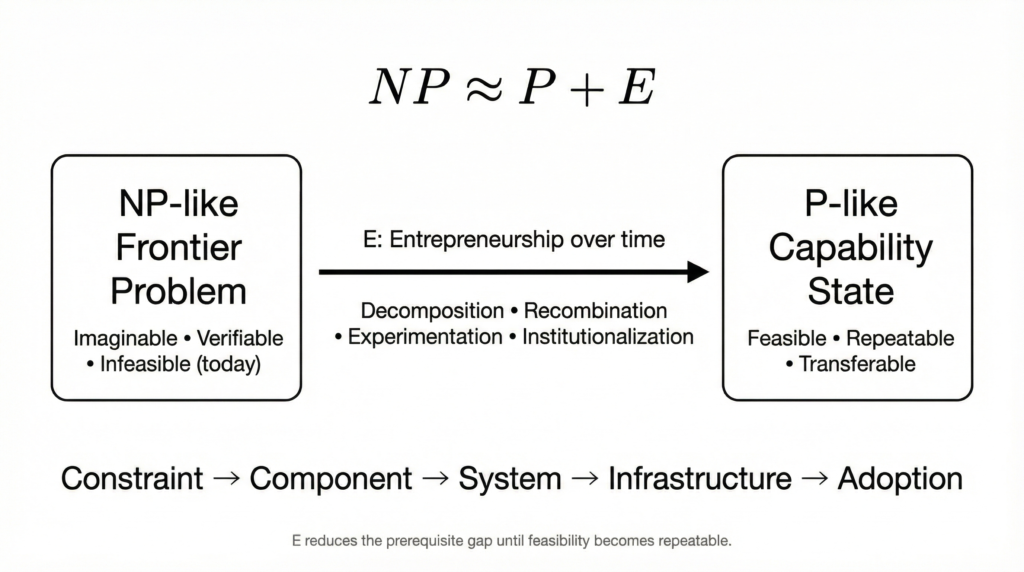
We argue that (most) startups begin their lifecycle in state ๐‘๐‘ƒ. The chaotic environment of a new venture is characterized by exponential difficulty. The goal of the entrepreneur is not merely to “take risks,” but to perform a specific computational function: transforming an ๐‘๐‘ƒ challenge into a ๐‘ƒย outcome.

This transformation is governed by the foundational relationship:

๐‘๐‘ƒ โ‰ˆ ๐‘ƒ+๐ธ

where Entrepreneurship (๐ธ) acts as the bridge between complexity and solvability. To quantify this process, this article introduces the Entrepreneurial Efficiency Equation, a mathematical model that decomposes (๐ธ) into critical variablesโ€”Problem-Solving (๐‘ƒs), Innovation (๐ผ), and Market Adaptability (๐ด)โ€”providing a structured approach to measuring how ventures bridge the gap between theoretical impossibility and operational reality.

ย 

The Quantification Gap

Foundational theories like Schumpeterโ€™s โ€œcreative destructionโ€ (1942) and the Resource-Based View (Barney, 1991) are qualitative. They describe what entrepreneurship is, but they fail to quantify how the process functions mechanically.

The Limitations of Current Models

Despite significant advancements, critical gaps remain. Models such as Leeโ€™s โ€œEntrepreneurial DNAโ€ (2013) or heuristic risk analysis analyze variables in isolation. While approaches like Structural Equation Modeling (SEM) test latent variables (Indurajani, 2020), they rarely integrate creativity, resources, and market dynamics into a unified system. Consequently, the field lacks practical applicability for strategic decision-making in real-time environments.

The Computational Bridge

To address this lack of integration, we turn to Computational Complexity Theory. The ๐‘ƒ โ‰  ๐‘๐‘ƒ problem explores whether problems whose solutions can be verified (๐‘๐‘ƒ) can be solved efficiently (๐‘ƒ). As noted by Byers (2011), this concept has profound implications for entrepreneurship, where challenges are often easy to identify but difficult to resolve due to limited resources.

We propose taking entrepreneurship not merely as a business activity, but as a heuristic process akin to computational problem-solving. This aligns with Aaronsonโ€™s (2011) observation that the implications of ๐‘ƒ โ‰  ๐‘๐‘ƒ extend beyond theoretical mathematics. By taking the venture as a mechanism (of entrepreneurial activity) for transforming intractable challenges into solvable solutions, we bridge the gap between theoretical complexity and practical action.ย 

ย 
ย 

Proposed Framework: The Entrepreneurship Mathematical Model

The gaps identified in the literature highlight the need for a unified framework that links internal capabilities with external constraints. Inspired by Karpโ€™s (1972) exploration of reducibility among combinatorial problems, we establish a foundation for integrating ๐‘ƒ โ‰  ๐‘๐‘ƒ-inspired thinking into entrepreneurship.

Note: We utilize a mathematical approach to move beyond descriptive theory. Mathematical models provide precision by distilling complex dynamics into measurable variables, enhancing predictive capability for risk assessment, and bridging the gap between economics and computer science.

To operationalize the governing relationship (๐‘๐‘ƒ โ‰ˆ ๐‘ƒ+๐ธ), we propose the Entrepreneurial Efficiency Equation, which models how actions operate within the context of ๐‘๐‘ƒ-like challenges:

 E = \frac{(P_{s} \times I) + (R \times A)}{e^{U} + N}


This equation highlights how entrepreneurship operates at the intersection of internal strengths and external constraints.

ย 
ย 
ย 
ย 

Internal Drivers (The Numerator)

The numerator represents the “Force” the venture applies to the problem.

  • Problem-Solving (๐‘ƒs): Defined as the efficiency in identifying and resolving multifaceted business challenges (Sarasvathy, 2001). We measure this by assessing the speed and precision of decision-making when facing ambiguity.
  • Innovation (๐ผ): The creativity required to develop novel solutions (Amabile, 1996). This is quantifiable through new product offerings or patent filings. In our model, ๐‘ƒs and ๐ผ are multiplicative; high effort (๐‘ƒs) with low innovation (๐ผ) yields only incremental progress.
  • Resources (๐‘…): The available financial, human, and social capital (Baker & Nelson, 2005). Measurement includes available funds and quantifying human capital (team skills and experience).
  • Market Adaptability (๐ด): The ability to pivot strategies in response to shifting market conditions (Eisenhardt & Martin, 2000; Ries, 2011). We measure this by tracking response times to market feedback. Resources (๐‘…) are only effective when multiplied by Adaptability (๐ด); otherwise, capital is inefficiently allocated.
ย 
ย 
ย 
ย 
ย 

External Drivers (The Denominator)

The denominator quantifies the friction that reduces the efficacy of the venture.

  • Exponential Uncertainty {e^{U}: Drawing from Knight (1921), we model external unpredictability as an exponential function. This highlights that incremental increases in volatility (e.g., regulatory shifts) disproportionately raise barriers to success.
  • Network Complexity (๐‘): While networks offer opportunities, they introduce coordination costs. We measure ๐‘ by analyzing stakeholder density, regulatory friction, and the difficulty of establishing trust in a new ecosystemย (Hoang & Antoncic, 2003).
ย 
ย 
ย 

The Transformative Logic

The equation underscores that entrepreneurship is not a random act, but a structured heuristic process. Successful entrepreneurs systematically transform ๐‘๐‘ƒ-like problems into manageable ๐‘ƒ-like solutions through three specific mechanisms:

  1. Iterative Learning: Unlike standard management, entrepreneurship solves for unknowns through high-velocity trial-and-error, directly increasing the efficiency of Problem-Solving (๐‘ƒs).
  2. Adaptive Innovation: Entrepreneurs allocate resources and refine solutions in real-time to align with emerging constraints. This synergy between Innovation (๐ผ) and Adaptability (๐ด) allows the venture to outmaneuver rigid competitors.
  3. Strategic Resource Allocation: Limited resources are deployed specifically to address high-priority “blocking” variablesโ€”such as reducing Network Complexity (๐‘) or mitigating Uncertainty e^Uโ€”rather than general operational growth.
ย 
ย 
ย 
ย 
ย 
ย 
ย 

The Equation in Action

The modelโ€™s value lies in its diagnostic capability. By isolating the primary constraint in the equation, we can define distinct strategies required to transform ๐‘๐‘ƒ problems into ๐‘ƒย solutions.

Case A: The Physics Approach (Solving for ๐‘ˆ)

  • Context: Deep Tech, Biotech, Aerospace (e.g., SpaceX).
  • The Constraint: The primary barrier is Exponential Uncertainty e^U. The risk is not market adoption, but physical or scientific feasibility.
  • The Strategy: Traditional logic suggests raising more capital (๐‘…) to survive. However, the equation demonstrates that linear increases in ๐‘…ย cannot overtake exponential ๐‘ˆ. To succeed, the venture must maximize Problem-Solving (๐‘ƒs) through first-principles thinking. By radically increasing the efficiency of the numerator, the venture creates enough “escape velocity” to overcome the exponential drag of uncertainty.

Case B: The Brute Force Approach (Solving for ๐‘…)

  • Context: Hardware Innovation (e.g., Dyson).
  • The Constraint: The founder operates with Resources (๐‘…) near zero. In the equation, a low ๐‘… typically collapses the numerator.
  • The Strategy: To balance the equation, the founder must push Problem-Solving (๐‘ƒs) to the limit. James Dyson created 5,127 prototypes over 15 years. The model proves that ๐‘ƒs and ๐‘…ย function as substitutes; a lack of capital must be compensated by extraordinary iteration speed and stamina.

Case C: The Adaptability Approach (Solving for ๐‘)

  • Context: The Sharing Economy (e.g., Uber, Airbnb).
  • The Constraint: The technology is manageable (๐‘ƒ), but Network Complexity (๐‘)โ€”regulatory hurdles and trust barriersโ€”is massive.
  • The Strategy: Success depends on Adaptability (๐ด). These companies utilized rapid strategic pivots to navigate high-friction environments. They directed their Resources (๐‘…) specifically toward lowering ๐‘ย (e.g., building trust systems), allowing network effects to shift from a barrier to a moat.
ย 
ย 
ย 
ย 

Discussion & Implications

While the Entrepreneurial Efficiency Equation offers a robust diagnostic tool, it is essential to acknowledge its constraints and its potential utility for stakeholders beyond the founder.

Model Constraints

As with any economic model, this framework simplifies complex realities:

  • Quantification Challenges: Variables such as Innovation (๐ผ) and Uncertainty (๐‘ˆ) are inherently subjective. While they can be estimated through proxies (e.g., patents filed, volatility indices), they are difficult to measure with absolute precision.
  • Dynamic Feedback Loops: The current equation presents a snapshot in time. In reality, entrepreneurship is non-linear; an increase in Resources (๐‘…) might paradoxically lower Adaptability (๐ด) if it leads to bureaucracyโ€”a feedback loop this version does not yet mathematically capture.
  • Contextual Variance: The weights of the variables change by industry. In pharmaceuticals, Problem-Solving (๐‘ƒs) is dominant; in fashion, Network Complexity (๐‘)ย may carry more weight.
ย 
ย 
ย 
ย 
ย 
ย 
ย 
ย 
ย 
ย 

Stakeholder Impact

The utility of the model extends beyond theoretical analysis, offering actionable insights for three key groups:

  • For Entrepreneurs: The equation forces a choice in resource allocation. If Uncertainty (๐‘ˆ) is exponential, spending capital on marketing (to address ๐‘) is inefficient. The strategy must shift to funding Problem-Solving (๐‘ƒs) to stabilize the product before scaling.
  • For Educators: Entrepreneurship curriculum often over-indexes on Business Plans (Planning for ๐‘ƒ). This framework suggests a pedagogical shift toward teaching “Heuristics for ๐‘๐‘ƒ“โ€”specifically, how to make decisions when variables are unknown e^U rather than merely optimizing known variables.
  • For Policymakers: Instead of generic funding, use the variables to assess ecosystem health. If capital is abundant (Highย ๐‘…) but growth is stagnant, the policy intervention should target lowering Network Complexity (๐‘) through deregulation, rather than providing more grants.
ย 
ย 
ย 
ย 
ย 
ย 
ย 
ย 

Conclusion

The Entrepreneurial Efficiency Equation shifts the view of startups from random chance to a function of variables. The equation

E = \frac{(P_s \times I) + (R \times A)}{e^U + N}

serves as a foundation for modeling entrepreneurship, offering three key contributions:

  1. Bridging Complexity and Action: It operationalizes the transformation of ๐‘๐‘ƒ-like problems (intractable) into ๐‘ƒ-like problems (manageable) through specific entrepreneurial actions.
  2. Quantifying Dynamics: It integrates critical variables to model how internal capabilities (Innovation, Adaptability) must scale to meet external threats (Uncertainty).
  3. Addressing Non-Linear Barriers: By treating Uncertainty as exponential, the model explains why “safe” businesses differ fundamentally from “moonshots,” requiring entirely different resource allocations.
ย 
ย 
ย 

For the entrepreneur, the operational mandate is simple: Increase the Numerator through agility and creativity, and Decrease the Denominator by systematically de-risking the venture. In doing so, they perform the ultimate function of business: turning the impossible (๐‘๐‘ƒ) into the routine (๐‘ƒ).

The frameworkโ€™s value lies in uniting theoretical rigor with practical applicability, empowering stakeholders to tackle complex challenges. Future research must focus on integrating AI and machine learning to empirically validate these variables, utilizing real-time data to refine the equation across diverse industries.

Ultimately, Entrepreneurship (๐ธ) may not fully convert ๐‘๐‘ƒ problems into ๐‘ƒ, but it systematically narrows the gap by bringing challenges closer to feasibility. The foundational relationship:

 NP \approx P + E

captures this transformative essence, portraying entrepreneurship not just as business creation, but as the critical bridge between complexity and solvability.

ย 
ย 
ย 
ย 

Acknowledgments

I extend my gratitude to Naseer Shaikh for introducing me to the intellectually stimulating topic of ๐‘ƒ โ‰  ๐‘๐‘ƒ. Our discussions served as the catalyst for this work, inspiring the core insight of translating computational complexity into a strategic framework for entrepreneurship.

References & Further Readings

  1. Aaronson, S. (2011). Why philosophers should care about computational complexity. Computational Complexity, 20(1), 57โ€“59.
  2. Amabile, T. M. (1996). Creativity in context. Westview Press.
  3. Argote, L., & Miron-Spektor, E. (2011). Organizational learning: From experience to knowledge. Organization Science, 22(5), 1123โ€“1137.
  4. Baker, T., & Nelson, R. E. (2005). Creating something from nothing: Resource construction through entrepreneurial bricolage. Administrative Science Quarterly, 50(3), 329โ€“366.
  5. Barney, J. (1991). Firm resources and sustained competitive advantage. Journal of Management, 17(1), 99โ€“120.
  6. Baron, R. A. (2006). Opportunity recognition as pattern recognition: How entrepreneurs โ€œconnect the dotsโ€ to identify new business opportunities. Academy of Management Perspectives, 20(1), 104โ€“119.
  7. Bontis, N., et al. (2021). Mathematical Modeling of Intellectual Capital and Business Efficiency of Small and Medium Enterprises. Mathematics, 9(18), 2305.

  8. Byers, T. H. (2011). Technology ventures from idea to enterprise.

  9. Chopra, K. N. (2015). Mathematical Modeling on “Entrepreneurship Outperforming Innovation” for Efficient Performance of the Industry. AIMA Journal of Management & Research, 9(3/4), 1-9.
  10. Cook, S. A. (1971). The complexity of theorem-proving procedures. Proceedings of the Third Annual ACM Symposium on Theory of Computing (pp. 151โ€“158).
  11. Eisenhardt, K. M., & Martin, J. A. (2000). Dynamic capabilities: What are they? Strategic Management Journal, 21(10โ€“11), 1105โ€“1121.
  12. Gilbert, N., & Ahrweiler, P. (2013). Agent-based modeling for entrepreneurship research: Opportunities and challenges. Emerald Insight.

  13. Gordijn, J., & Akkermans, H. (2015). Business model analysis using computational modeling: A strategy tool for exploration and decision-making. ResearchGate.ย 

  14. Indurajani. (2020). Structural equation model of corporate entrepreneurship: A study. SSRN Electronic Journal.ย 
  15. Karp, R. M. (1972). Reducibility among combinatorial problems. Complexity of Computer Computations (pp. 85โ€“103). Springer.
  16. Kedi, O., Verstiak, A., Kruhlyanko, A., & Ursakii, Y. (2024). Mathematical Modeling for Enhancing Business Strategies in the Hotel and Restaurant Industry. Advances in Nonlinear Variational Inequalities, 28(3s), 386-402.

  17. Keyhani, M., Lรฉvesque, M., & Madhok, A. (2019). Computational modeling of entrepreneurship grounded in Austrian economics: Insights for strategic entrepreneurship and the opportunity debate. Journal of Business Venturing, 34(5), 105886.
  18. Knight, F. H. (1921). Risk, uncertainty, and profit. Houghton Mifflin.
  19. Lee, J. (2013). Mathematical modeling and quantitative analysis of entrepreneurship. Proceedings of the International Conference on Industrial Engineering and Operations Management.
  20. Magd, H., & Thirumalaisamy, R. (2024). Effects of Entrepreneurship, Organization Capability, Strategic Decision Making and Innovation toward the Competitive Advantage of SMEs Enterprises. Research Gate, Retrieved January 24, 2025.

  21. Mintzberg, H. (1979). The structuring of organizations: A synthesis of the research. Prentice Hall.
  22. Mitchell, M. (2009). Complexity: A guided tour. Oxford University Press.
  23. Porter, M. E. (1980). Competitive strategy: Techniques for analyzing industries and competitors. Free Press.
  24. Ries, E. (2011). The Lean Startup: How constant innovation creates radically successful businesses. Crown Publishing Group.
  25. Sarasvathy, S. D. (2001). Causation and effectuation: Toward a theoretical shift from economic inevitability to entrepreneurial contingency. Academy of Management Review, 26(2), 243โ€“263.
  26. Sarkar, D., et al. (2024). Analyzing the nexus between entrepreneurship and business mathematics – a comprehensive study on strategic decision-making, financial modeling, and risk assessment in small and medium enterprises (SMEs). International Journal of Research and Review, 11(2), 41-53.

  27. Schumpeter, J. A. (1942). Capitalism, socialism, and democracy. Harper & Brothers.
  28. Shane, S., & Venkataraman, S. (2000). The promise of entrepreneurship as a field of research. Academy of Management Review, 25(1), 217โ€“226.
ย