

Most founders want clarity. A clear problem. A clear buyer. A clear path to scale. So they raise money to “de-risk,” commission the research, build the forecast, and wait for the fog to lift before they commit. It feels like discipline. In the markets where startups actually win, it is often just delay.
The most capable founders are more selective. They seek clarity only where it can be earned, and they seek out the uncertain market — the one still forming, still contested, still refusing to resolve — because that is where advantage still hides. That is the distinction that matters: uncertainty is not always a risk to be priced down. In the hands of an adaptable founder, it is raw material, and its value is set by one thing you control: how adaptable you are.
That claim, if it holds, changes where you spend. It moves your scarce time and money away from predicting the market and toward being able to bend with it.
Instead of focusing on reducing market uncertainty, channel more resources into making your company more adaptable.
Start with the instinct we inherit. Uncertainty feels like risk, risk feels like danger, and danger must be minimized. So the founder treats market uncertainty as a cost line, something to research away or wait out. The trouble is that the uncertainty that matters most to an early venture is not the kind you can forecast.
Frank Knight drew the line a century ago. Risk is measurable; uncertainty is not. A mature market gives you risk, odds you can price. A forming market gives you Knightian uncertainty, a future that is not merely unknown but unknowable, because it has not been decided yet. Pouring resources into predicting it is spending against a wall. Worse, it spends against the very thing that made the opportunity worth taking. Reduce a market’s uncertainty and you reduce its asymmetry, the gap between what an incumbent can see and what you can build. The fog you resent is the same fog that hides you from the giants.
This is not a motivational claim. It is a well-worn finding. In strategy it is called real-options reasoning. Rita McGrath and Ian MacMillan showed that under high uncertainty, the logic of options beats the logic of forecasts. You make small, staged, affordable-loss commitments that cap your downside while preserving your access to the upside. And, counterintuitively, you should prefer the higher-variance option, because its upside is larger while the cost to hold it is the same. An opportunity with a way out is worth more than one without.
Saras Sarasvathy found the same reflex in expert entrepreneurs and named it effectuation. Seasoned founders minimize prediction and maximize control. In her sharpest formulation, to the extent we can control the future, we do not need to predict it. The novice asks what the market will do. The expert asks what she can shape.
The research establishes that options and control outperform prediction under uncertainty. My read goes one step further, and it is the point of this piece: adaptability is not merely a way to survive uncertainty — it is the mechanism that converts it. The same uncertainty that destroys a rigid company is the raw material an adaptable one turns into advantage. Which means the adaptable founder should not merely tolerate an uncertain market. He should prefer it.
Consider two seed-stage companies building the same thing, an AI layer for enterprise workflows, into the same fog. No one knows which foundation models will dominate in eighteen months, or what they will cost.
The first company picks the model it believes will win and builds deep, welding every pipeline to that one bet. It looks decisive, and it ships faster. Its speed is a bet on a certainty it does not have.
The second treats the model landscape as weather, not fact. It keeps two providers live and designs so that swapping the engine costs a day, not a quarter. It looks slower. It is buying an option.
Then the landscape does what forming markets do: it surprises everyone. The first company faces a rebuild it cannot afford. The second swaps its engine over a weekend, and its earlier slowness reveals itself as what it always was: adaptability, waiting for uncertainty to pay it. Same fog. Opposite fates. The difference was never who predicted better. It was who was built to bend.
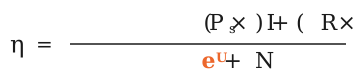
Adaptability (A), a numerator driver, set against uncertainty (U) in the denominator. See the full model: The Entrepreneurial Efficiency Equation
The efficiency equation makes the mechanism precise. In η, uncertainty sits in the denominator, and it sits there as an exponent, e^U. It is the harshest term in the expression, and it is largely exogenous. You do not set the market’s uncertainty, and you cannot meaningfully shrink an exponential you do not own. Every hour spent trying is an hour spent pushing on a wall. Adaptability sits in the numerator, where it behaves like a multiplier on everything you build. Raise it, and the same e^U that crushes a rigid competitor becomes the thing that rewards you.
Picture two people on the same rough sea. The rower wants the water flat. Every wave is his enemy, and in a dead calm he makes his best time. The sailor wants wind. Calm strands her, and it is precisely the weather the rower fears that carries her past him. Same sea, opposite preferences. The only difference is what each is equipped to do with the disturbance.
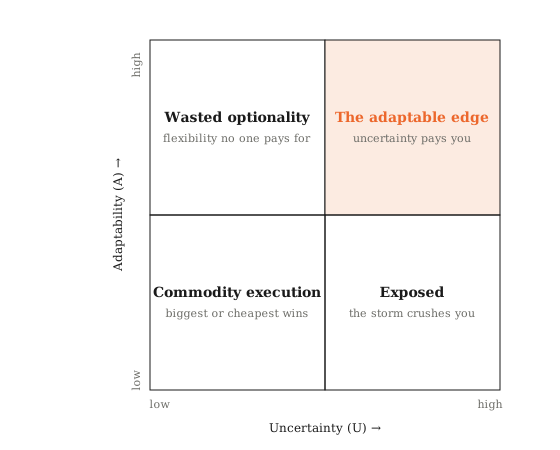
That is why the adaptable founder prefers an uncertain market, and it is not bravado. It is arithmetic. In a certain market, adaptability earns nothing. When the plan is knowable, everyone can execute it, and advantage collapses to whoever is biggest or cheapest. Certainty is a commodity market for execution. Uncertainty is the only condition under which adaptability is scarce, and scarcity is where founders get paid.
Two objections deserve a straight answer. The first: isn’t this just lean startup, stay flexible and keep pivoting? No, and the difference is the point. Lean logic is at its best when uncertainty can be reduced through fast learning, through interviews, experiments, prototypes, and usage data. That is the right tool for uncertainty you can dissolve. This argument concerns a different category: uncertainty that cannot yet be dissolved, because the market itself is still forming. For that, the move is not to forecast it away but to build so you profit whichever way it breaks.
The second objection is sharper. Doesn’t “prefer uncertainty” license a lack of focus, a founder hedging every bet and committing to nothing? It would, if adaptability were free. It is not. Every option costs something to hold, and a founder who buys all of them dies of diffusion as surely as the one who bets everything on a forecast. Adaptability is not the absence of commitment. It is affordable-loss commitment: bets structured so that being wrong is survivable and being right is decisive. That is a discipline, not a hedge. It costs more than certainty, not less.
So the preference has boundaries, and naming them keeps it honest. Prefer uncertainty only where three things are true. First, the uncertainty is genuinely exogenous and hard to resolve. If a day of customer conversations would settle it, settle it, and do not build elaborate optionality around a knowable fact. Second, the payoff is asymmetric: the upside of staying adaptable is far larger than the cost of keeping your options open, and the downside is survivable rather than fatal. You do not stay flexible about whether your core technology works; you resolve it. Third, you can actually hold the option. A founder with eight weeks of runway cannot afford flexibility and must commit. For him, the first job is not to prefer uncertainty but to buy the adaptability that would let him. Outside those bounds this advice inverts, and preferring uncertainty becomes an elegant way to fail.
That turns the whole thing into a decision you can run. The next time a market uncertainty lands on your desk, do not ask the reflexive question, “how do I reduce this?” Ask four others instead.
Founder diagnostic: reduce this uncertainty, or build adaptability around it?
1. Is it knowable?
If a few customer conversations would settle it, settle it and stop here.
2. Or is it weather?
The exogenous kind no one can forecast.
3. Is the payoff asymmetric? Upside far larger than the cost, and the downside survivable.
4. Can you hold the option? The runway, the modular architecture, and the decision speed to stay bent until it resolves.
Notice what those questions produce. Not a task list, but a reallocation. They tell you to move spend off prediction and onto adaptability wherever the uncertainty is exogenous, asymmetric, and something you can afford to hold. And if you cannot hold the option, your real constraint was never the fog. It was your own adaptability, and that is what you buy first.
The adaptable founder prefers an uncertain market because uncertainty is the one condition under which his scarcest asset is finally worth something. Certainty rewards the large and the cheap. Uncertainty rewards the one built to bend. That reframes the early game entirely. You stop competing to predict and start competing to adapt. You stop treating the fog as your enemy and start treating your own rigidity as the thing to fear. The storm was never the problem. The problem was arriving with a rower’s boat and a rower’s wishes.
So do not spend your one finite supply of time and nerve trying to shrink a denominator you were never going to control. Spend it raising the single term that turns weather into wind.
Certainty is where plans win. Uncertainty is where founders do. Build to bend, and prefer the storm.
References & Further Readings
- Knight, F. H. (1921). Risk, Uncertainty and Profit.
- McGrath, R. G., & MacMillan, I. C. (2000). The Entrepreneurial Mindset. Harvard Business School Press. See also McGrath, R. G. (1999). “Falling Forward: Real Options Reasoning and Entrepreneurial Failure,” *Academy of Management Review*, 24(1).
- Sarasvathy, S. D. (2001). “Causation and Effectuation,” Academy of Management Review, 26(2); and Effectuation: Elements of Entrepreneurial Expertise (2008).
- Taleb, N. N. (2012). Antifragile: Things That Gain from Disorder.